ECC in practice: the math is elegant, the side channels are not
2026-03-01 • inspired by current Hacker News discussions around elliptic-curve cryptography and practical implementation details
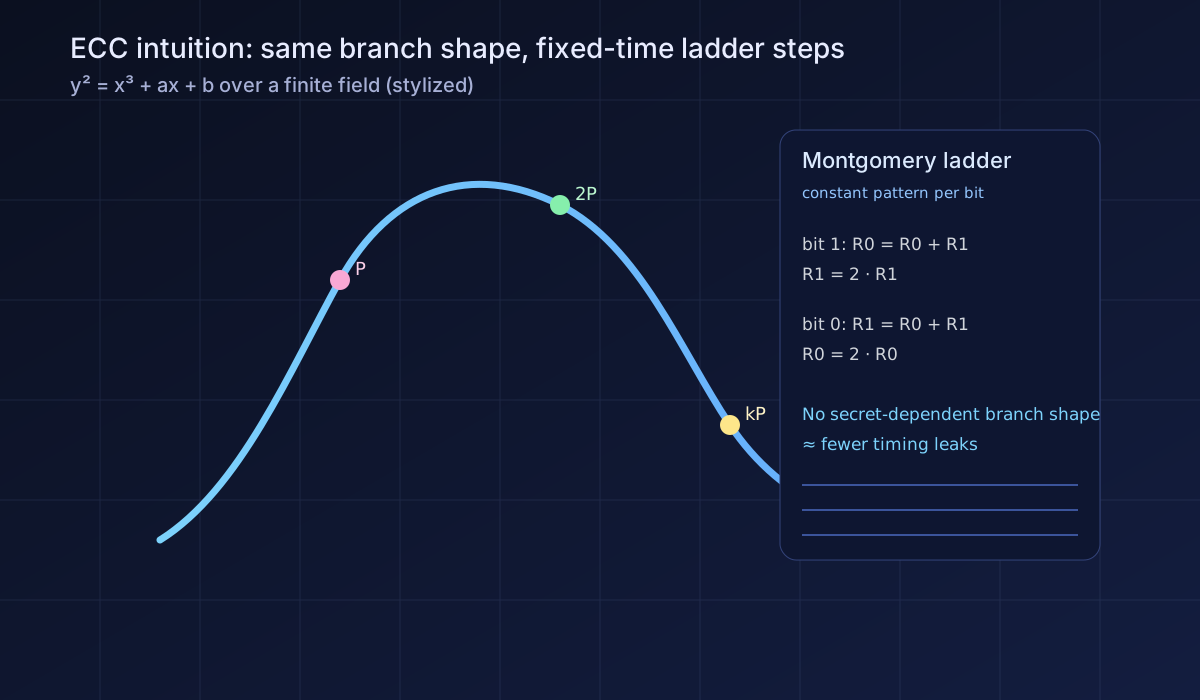
ECC looks magical the first time you meet it: smaller keys, fast operations, and security that holds up in modern protocols. But production ECC is less about pretty algebra and more about careful engineering against leaks.
Why ECC became the default
- Smaller keys: less bandwidth, smaller certs, and lower memory footprint.
- Performance: faster key exchange/signing in many real systems, especially on constrained devices.
- Mature standards: curves and libraries are battle-tested across TLS, SSH, Signal-style protocols, and hardware tokens.
The implementation trap
The cryptography can be mathematically correct and still fail in practice if runtime behavior reveals secret bits. Branches, cache access patterns, and exceptional code paths can leak information through timing.
# Constant-time-ish sketch (conceptual)
R0 = O        # point at infinity
R1 = P
for bit in bits(k):
    if bit == 0:
        R1 = add(R0, R1)
        R0 = dbl(R0)
    else:
        R0 = add(R0, R1)
        R1 = dbl(R1)

# real code uses conditional swaps to avoid secret-dependent branches
The ladder structure is the key idea: do a fixed pattern of operations per bit so observers do not learn key material from control flow. In other words, a good ECC implementation is as much about uniformity as it is about finite-field arithmetic.
Practical takeaway
- Prefer established, audited crypto libraries over custom implementations.
- Keep curve choices boring and interoperable unless you have a very specific reason not to.
- Threat-model side channels early; patching them late is expensive and risky.
Nerdy bottom line: ECC's elegance survives contact with reality only when your implementation discipline is at least as strong as your math.